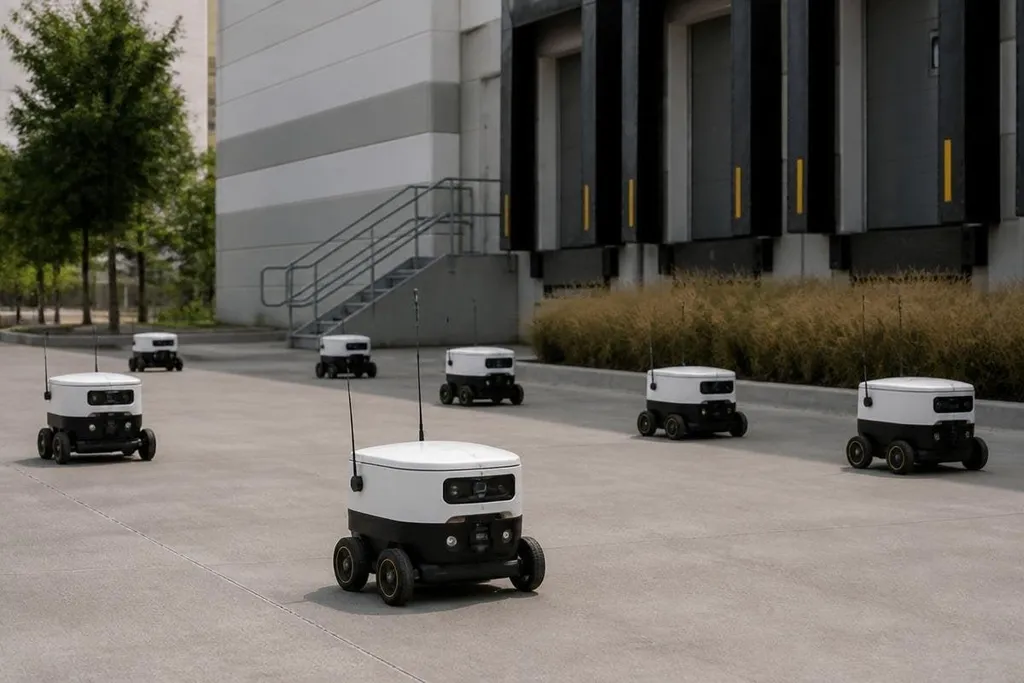
A robot swarm spreads work across many machines instead of sending every move through one controller. Each robot follows local rules, shares limited information, and changes its actions when nearby robots or the wider task changes.
This approach can help a group search an area, move goods, map a site, or inspect equipment. It also creates hard problems around communication, safety, charging, and fault recovery.
Quick read
- Local rules guide each robot’s next action.
- Shared signals help the group divide work without one machine directing every move.
- A swarm can keep working after a robot fails, but only when the task and software allow it.
The basic control loop
A swarm robot starts with sensors, a task, and a set of rules. Its sensors may detect nearby robots, walls, objects, people, location markers, or changes in the work area. The robot uses that information to choose its next move.
Usually, the robot sees only part of the whole task. It may know that an area needs checking, but not which robot should check each section. Local rules help fill that gap. A rule might tell the robot to move toward an unvisited area, keep a safe distance from its neighbors, or stop when a person enters its path.
The group’s behavior comes from many small decisions. No single robot needs a complete map of every robot’s position, though the group may still use a shared map or a central planning service for selected tasks.
That distinction matters. A swarm is not defined by having no central computer. It is defined by how much control stays with the individual robots and how the group shares work.
How robots divide the work
Task allocation is the part that turns a group into a working system. Robots can claim jobs, pass work to nearby machines, or use signals that show which areas have already been handled.
One method uses an auction. For each job, the robot estimates the time, distance, battery use, or risk, then sends a bid. The group assigns the job to the robot with the best fit under the system’s rules.
Another method uses shared markers. After checking a location, the robot leaves a digital record, and nearby robots avoid repeating that work. In physical settings, robots may also react to traces left in the environment, such as a marked route or a changed object position.
Communication does not need to be constant. A short message can say that a robot has claimed a shelf, found an obstacle, or needs a charge. Less traffic can help when wireless coverage is weak, but it also means the group may work with old information.
That trade-off becomes harder when one robot drops out. A swarm needs a way to notice the missing robot and reassign its task; reports on swarm robotics can give you named systems and test details to compare before the next section looks at failure.
What happens when a robot fails
Fault recovery is one reason engineers study swarms. If one robot stops, nearby machines may take over its unfinished work, provided they can detect the failure and reach the task.
That recovery has limits. A blocked passage, dead battery, damaged sensor, or lost wireless link can affect several robots at once. A group also needs rules that prevent many robots from rushing toward the same replacement job.
Safety adds another layer. Robots need limits on speed, distance, force, and access to shared spaces. A swarm moving through a warehouse cannot treat every open route as available if people, forklifts, or maintenance crews use the same floor.
The software must also handle uncertainty. Sensors can miss objects, location estimates can drift, and two robots can receive different views of the same area.
Tests in simulation help, but a real site adds lighting changes, blocked paths, dust, and network gaps.
Where swarms fit
Swarm control makes the most sense when a task can be split into small pieces. Search, mapping, stock movement, crop checks, and inspection can fit that pattern when robots can work apart and share results.
A single large robot may suit work that needs high force, exact placement, or a heavy tool. A swarm may be a poor fit when every step depends on one fixed sequence, since local decisions can add coordination work rather than remove it.
The cost also sits beyond the robot’s purchase price. You may need charging points, spare units, wireless coverage, fleet software, site maps, safety checks, and staff who can respond when the rules fail.
I'd choose a swarm only when the work can continue after a robot drops out and the site can keep people clear of the machines.
A practical buying checklist
Before choosing swarm automation, check:
- Task shape: Can the work split into repeatable jobs with clear boundaries?
- Robot loss: What happens when one machine stops halfway through a task?
- Communication: How much work can continue during a network outage?
- Safety space: Where will people, vehicles, and robots share access?
- Charging plan: Can the group keep enough robots ready without stopping work?
- Proof run: Can the supplier show results in a site that matches yours?
The open test is not whether many robots can move together in a video. It is whether the group can divide work, recover from faults, and stay safe when the site stops behaving like the test plan.